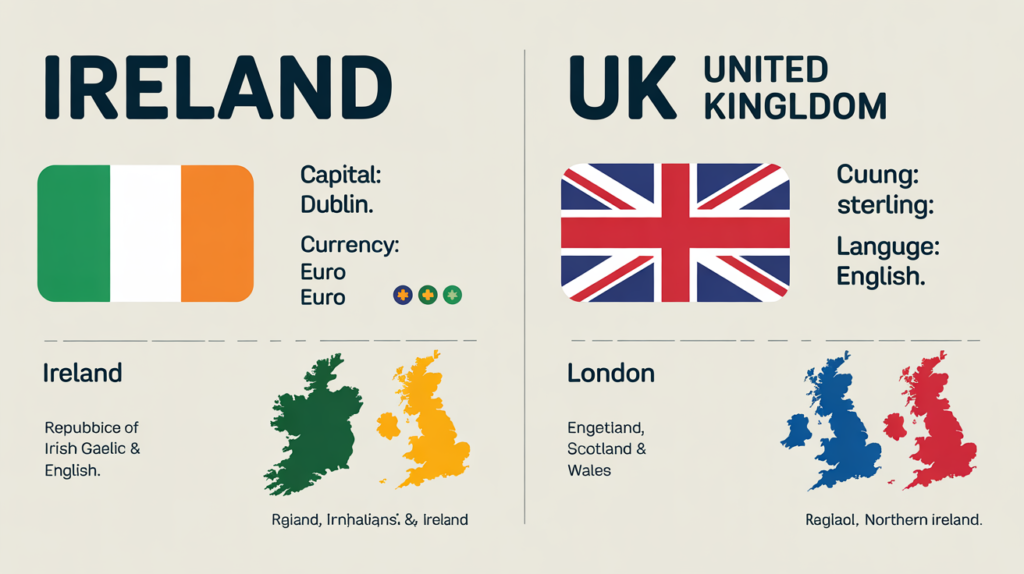
When people talk about Ireland and the United Kingdom, it’s easy to assume they’re culturally identical. After all, they’re neighbors, they share a long (and complicated) history, and they even speak the same primary language. But if you spend even a short amount of time in both places—as I have—you’ll quickly realize that the differences run deeper than most people expect.
From humor and communication styles to food, traditions, and everyday behavior, Ireland and the UK each have their own distinct identity. In this post, I’ll break down those cultural differences in a clear, practical way—especially helpful if you’re planning to visit, move, or just want to understand both cultures better.
1. Identity and National Pride
One of the biggest differences between Ireland and the UK is how people view their national identity.
In Ireland, national identity is deeply emotional and closely tied to history, independence, and cultural preservation. There’s a strong sense of pride in Irish heritage—whether it’s language, music, or storytelling. Even everyday conversations can reflect this pride, especially when it comes to traditions or historical struggles.
In contrast, the UK (which includes England, Scotland, Wales, and Northern Ireland) has a more layered identity. Someone from Scotland, for example, may identify as Scottish first and British second. In England, people often identify simply as English rather than British.
My experience:
When I visited Ireland, I noticed people were very open about their Irish identity—it came up naturally in conversations. In England, identity felt a bit more understated and less emotionally expressed.
2. Communication Style
At first glance, both cultures seem similar in how they communicate—but subtle differences matter.
Ireland:
- More conversational and expressive
- Friendly, informal, and often chatty
- People tend to engage in longer small talk
UK:
- More reserved and structured
- Politeness is extremely important
- Conversations can feel more formal, especially with strangers
In Ireland, it’s completely normal to strike up a conversation with someone in a shop, pub, or even on the street. In parts of the UK—especially England—people are generally more private and less likely to initiate casual chats with strangers.
Example:
In Ireland, a simple “How are you?” might lead to a genuine, extended conversation. In England, it’s often just a polite greeting with a short reply.
3. Humor: Similar Roots, Different Flavors
Both Ireland and the UK are famous for their humor, but the style differs slightly.
Irish Humor:
- Storytelling-based
- Self-deprecating but warm
- Often includes exaggeration and charm
British Humor:
- Dry and sarcastic
- More subtle and sometimes harder to detect
- Often includes irony and understatement
Irish humor tends to feel more lively and personal, often involving anecdotes or dramatic storytelling. British humor, on the other hand, can be more understated—you might miss the joke if you’re not paying attention.
Personal insight:
In Ireland, I found myself laughing more openly. In England, I sometimes needed a second to realize someone had just made a joke.
4. Social Life and Pub Culture
Both cultures value socializing, but the vibe can differ.
Ireland:
Pubs are central to social life. They’re not just for drinking—they’re community hubs where people gather, talk, listen to music, and connect.
- Live traditional music is common
- Conversations with strangers are normal
- Warm, welcoming atmosphere
UK:
Pubs are also important, but the experience can vary more depending on location.
- Some pubs are lively, others quieter
- Less spontaneous interaction with strangers
- More structured social groups
My experience:
In Ireland, I felt instantly included—even as a visitor. In parts of the UK, social circles felt a bit more closed unless you were introduced.
5. Food Culture
Food is another area where differences show up clearly.
Irish Food:
- Hearty, traditional, and comforting
- Focus on fresh, local ingredients
- Popular dishes: stews, soda bread, seafood
UK Food:
- More diverse due to multicultural influences
- Wide range of international cuisines
- Traditional dishes still exist but are less dominant
Ireland’s food culture feels more rooted in tradition and local produce. The UK, especially in big cities, offers a much broader global food scene.
Observation:
In Ireland, meals often felt homemade and traditional. In the UK, especially London, I had access to food from all over the world within minutes.
6. Attitudes Toward Time and Lifestyle
Lifestyle pace is another noticeable difference.
Ireland:
- More relaxed and laid-back
- People value conversation and connection
- Less pressure around strict schedules
UK:
- Faster-paced, especially in cities
- More structured and time-conscious
- Efficiency is often prioritized
In Ireland, things can feel slower—but in a good way. There’s more emphasis on enjoying the moment. In the UK, particularly in urban areas, life tends to move faster.
7. Language and Accents
Even though both countries primarily speak English, the differences in accents and expressions are significant.
Ireland:
- Distinct accents depending on region
- Unique phrases and slang
- Influence from the Irish language
UK:
- Huge variety of accents (English, Scottish, Welsh, etc.)
- Regional slang varies widely
- More standardized in formal settings
Sometimes, even native English speakers can struggle to understand certain accents in both countries.
Tip:
Don’t be afraid to politely ask someone to repeat themselves—it’s completely normal.
8. Traditions and Cultural Expressions
Ireland and the UK both have rich traditions, but they emphasize different aspects.
Ireland:
- Strong focus on music, dance, and storytelling
- Cultural traditions are deeply preserved
- Festivals often celebrate heritage
UK:
- Traditions vary widely across regions
- Mix of old customs and modern influences
- More diversity in cultural expression
Irish culture often feels more unified and rooted in shared traditions, while UK culture is more diverse and regionally varied.
9. Friendliness and Social Openness
This is one of the most noticeable differences for visitors.
Ireland:
- Known for friendliness and warmth
- Easy to start conversations
- Welcoming to outsiders
UK:
- Polite but more reserved
- Friendliness may take time to develop
- Social boundaries are more defined
My personal takeaway:
Ireland felt immediately welcoming, while in the UK, connections felt more gradual—but still genuine once established.
10. Historical Influence on Culture
History plays a major role in shaping cultural differences.
Ireland’s history, particularly its struggle for independence, has created a strong sense of cultural identity and pride. This influence can still be felt in everyday life, from language to traditions.
The UK, with its long history as a global power, has developed a more diverse and complex cultural landscape influenced by many different regions and peoples.
Understanding this historical context helps explain why the cultures feel different despite geographic proximity.
11. Approach to Hospitality
Hospitality is important in both places, but it’s expressed differently.
Ireland:
- More personal and informal
- Guests are often treated like family
- Generosity and warmth stand out
UK:
- Polite and respectful
- More structured and formal
- Hospitality may feel less personal initially
12. Everyday Etiquette
Small everyday behaviors also highlight cultural differences.
Ireland:
- More relaxed approach to rules
- Casual interactions are common
- Humor often used in daily communication
UK:
- Strong emphasis on manners
- Queuing (lining up) is taken very seriously
- Politeness is essential in all interactions
Final Thoughts
While Ireland and the UK may seem similar on the surface, their cultural differences become clear once you experience both.
- Ireland feels warmer, more conversational, and deeply rooted in tradition
- The UK feels more structured, diverse, and regionally varied
Neither is better—they’re simply different in ways that make each unique and interesting.
If you’re planning to visit both:
Take the time to appreciate these differences rather than compare them. You’ll enjoy your experience much more.
My Personal Reflection
Having spent time in Ireland and the UK, I can honestly say that both places left a strong impression on me—but in different ways.
Ireland stood out for its warmth, storytelling, and sense of community. The UK impressed me with its diversity, efficiency, and cultural depth.
If I had to sum it up in one sentence:
Ireland feels like a conversation, while the UK feels like a system.
And experiencing both? That’s what makes travel truly worthwhile.

Hi, I’m Tanvir, the founder and author of Explore Ireland Now. With a deep love for Ireland and its rich culture, history, and landscapes, I created this site to share everything that makes this beautiful country worth exploring. Whether you’re a local looking for hidden gems or a traveler planning your next adventure, I provide insightful guides, tips, and recommendations to help you experience Ireland to the fullest.
From stunning landscapes to vibrant cities and quaint villages, Ireland is full of wonders waiting to be discovered. Through my personal experiences and research, I aim to bring you the most up-to-date information and inspiration for your journey.
Thank you for visiting Explore Ireland Now—I hope my content helps you uncover all that this incredible country has to offer! If you have any questions or need travel advice, feel free to reach out.